


Mexico: Church steps up to confront violence with message of peace
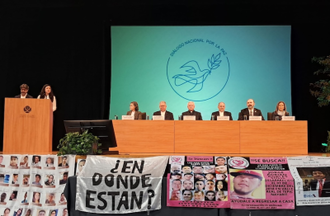
National Dialogue for Peace
GUADALAJARA - A Catholic church-sponsored conference held here earlier this week brought together more than 1,000 activists and concerned citizens from across Mexico to share strategies and hone tactics among civil society groups in efforts to stem widespread violence and rights abuses that continue to plague the country.
Known as the National Dialogue for Peace, the three-day conference at the Jesuit ITESO university here was the second to be held as part of an ongoing movement launched by the Jesuits' Mexico province in 2022 with the support of the country's Catholic hierarchy to address the alarming level of violence that has spread to virtually all corners of Mexico in recent years.
The conference was inaugurated by Cardinal Francisco Robles Ortega, Archbishop of Guadalajara, who was joined on the dais by the Secretary General of the Mexican Bishops Conference, Auxiliary Bishop Hector Perez Villarreal of Mexico City, along with the President of the Conference of Major Superiors of Mexican Religious Orders and the provincial head of the Jesuits in Mexico.
Cardinal Robles told the assembled community leaders, advocates for social justice and human rights, educators, youth workers, leaders of various religions and representatives of Mexico's private sector that as an antidote to the violence that has enveloped Mexico they must remain steadfast in working at every level to maintain the country's social fabric.
"Sow seeds of peace in every corner of the country, from the family, the street, the school, the neighbourhood, and the workplace," he told them, "in spaces where violence is transformed into signs of hope, to regain control of our lives and build what many of us have often neglected: community."
Bishop Perez exhorted the conference delegates not to lose hope, telling them that "We are all here because, despite the tiredness, the fear, the rage that keeps accumulating, the helplessness and all the absences that tear and wound our hearts, there is something that still does not break, the certainty that violence cannot be our final destination."
Now widespread and reaching into virtually every corner of the country, the violence which the National Dialogue for Peace hopes to counter began among warring drug cartels in the north of the country trafficking narcotics into the United States. But two decades ago, triggered by the Mexican government's launch in 2006 of an all-out military campaign against the cartels, the violence began spiralling out of control.
Shortly thereafter, say security analysts and human rights workers in Mexico, the introduction into Mexico of large quantities of high-powered assault weapons, purchased legally by individuals in United States and smuggled across the border, made their way into the hands of of Mexico's cartels and criminal gangs. The violence skyrocketed and has shown no signs of abating since.
In the intervening years, the country's civilian population has been caught squarely in the cross-fire between warring cartels and battles between the cartels and Mexico's various military and police forces. The result has been a staggering number of homicides - as many as 300,000 over the past two decades, with 30,000 people killed every year since 2018. Human rights groups place the number of people forcibly disappeared as high as 135,000 - more than half of whom are undoubtedly the 75,000 cadavers still waiting to be identified in morgues across the country.
With Mexico holding the second largest Catholic population of any country worldwide, it's 103 million Catholics comprising 78 percent of the total population, the Catholic church has not escaped unscathed.
The vast majority of the thousands of those killed and disappeared have been lay Catholics and the institutional church has also lost 80 priests and seminarians in targeted murders linked to the ongoing violence.The National Dialogue for Peace movement itself emerged in 2022 in part as response following the murder by a criminal gang of two Jesuit priests working in the northern state of Chihuahua.
According to Maria Luisa Aguilar, executive director of the Jesuits' Miguel A Pro Center for Human Rights, the problem with combatting the violence in Mexico today is that it is no longer solely associated with Mexico's drug cartels.
She says the influx of heavy weaponry smuggled into the country served to embolden criminal gangs, some linked to the cartels and others not, leading to the spread of organized crime activity - from racketeering to extortion to the hijacking of cargo and shipments of oil and gasoline - into virtually every sector of the Mexican economy throughout the country. And pervasive criminal activity at the local and regional level, she says, has spawned corruption at all levels of government, with politicians and some sectors of the military itself in league with various criminal organizations.
The Mexican government's response of beefing up the military's presence throughout the country in order to deal with the cartels and organized criminal gangs has not resolved the problem, but instead has exacerbated the violence in many areas, adds Aguilar.
"There is nothing that indicates to us that in the last 20 years putting the armed forces to the fore has resolved the violence - on the contrary, it has increased human rights violations by the armed forces themselves."
Acknowledging the grim scenario, Bishop Perez said the National Dialogue for Peace conference in Guadalajara was "an act of collective hope in a country that seems to have normalized corruption, lies, and violence."
By coming together in the name of peace, to all those responsible for the violence crippling Mexico today, he said "we want to say clearly and loudly, only the truth, only the restoration of justice, only reconciliation will bring us peace. And in this task, we will all be involved."
Michael Tangeman is a journalist and author of the book Mexico at the Crossroads: Politics, the Church, and the Poor.
 Facebook
 Twitter
 LinkedIn
 Print
Print Email
Email














 Facebook
 Twitter
 YouTube
 LinkedIn
 Pinterest