

Gospel in Art: Saint Thomas Aquinas, Priest, Doctor
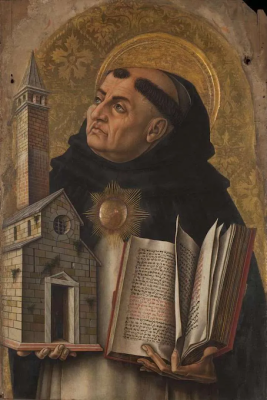
Saint Thomas Aquinas by Carlo Crivelli, 1476 © National Gallery, London
Source: Christian Art
Gospel of 28 January 2026
Matthew 23:8-12
At that time: Jesus said to his disciples, 'You are not to be called rabbi, for you have one teacher, and you are all brothers and sisters. And call no man your father on earth, for you have one Father, who is in heaven. Neither be called instructors, for you have one instructor, the Christ. The greatest among you shall be your servant. Whoever exalts himself will be humbled, and whoever humbles himself will be exalted.'
Reflection on the painting
Today, we celebrate the Feast of St Thomas Aquinas, one of the most influential theologians and philosophers in the history of Christianity.
Among the few artistic depictions of Aquinas, our painting by Carlo Crivelli, is perhaps the most iconic.
Frequently reproduced in publications discussing Aquinas, this panel was originally part of a larger work, the Demidoff Altarpiece, created for the church of San Domenico in Ascoli in the late 15th century. Interestingly, dedicated stand-alone portrayals of St Thomas are rare, and this panel itself serves more as a fragment of a larger narrative than an independent homage to the saint.
Crivelli's craftsmanship in this work is remarkable, employing techniques that bring the image to life with a sense of depth. The gilding is highly tooled, with intricate punching, and incising, particularly around the saint's halo, creating a three dimensional luminous effect that would have shimmered beautifully in the candlelit interior of its original setting. The use of pastiglia, a technique where raised areas are created on the surface, adds further dimension, most notably in the brooch resting over St Thomas' heart. This detail symbolises that Aquinas' teachings were not only intellectual pursuits but also deeply rooted in his heart and soul, encapsulating the harmonious balance of faith and reason.
Saint Thomas Aquinas (1225-1274) was an Italian Dominican priest, born into a noble family in Roccasecca, near Aquino. He was educated at the Benedictine monastery of Monte Cassino and later at the University of Naples, where he encountered Aristotelian philosophy. Against his family's wishes, he joined the Dominican Order, dedicating his life to the pursuit of truth through study, teaching, and writing. Aquinas studied in Cologne and Paris, where he developed his profound synthesis of faith and reason, integrating Aristotelian philosophy with Christian theology. His most famous work, the Summa Theologica, remains a cornerstone of Catholic doctrine. He also wrote numerous commentaries on Scripture, and authored hymns such as Pange Lingua and Tantum Ergo, still used in Catholic liturgy today. Declared a Doctor of the Church in 1567, Aquinas is celebrated as the "Angelic Doctor" for his unparalleled intellect and deep spirituality.
LINKS
Gospel in Art: https://christian.art/
Today's Reflection: https://christian.art/daily-gospel-reading/matthew-23-8-12-2026/
 Facebook
 Twitter
 LinkedIn
 Print
Print Email
Email















 Facebook
 Twitter
 YouTube
 LinkedIn
 Pinterest