


Ireland: Churches' environmental conference prompted by pollution of Lough Neagh
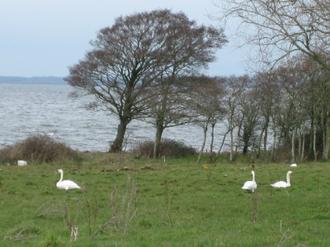
Lough Neagh - Image by Brian Shaw - licence: CC BY-SA 2.0 CC BY-SA 2.0
Source: Irish Catholic Media Office
A full-to-capacity conference of up to 200 people met today in the Canal Court Hotel in Newry, Co Down, organised by Ireland's Church Leaders' Group, the Irish Council of Churches and the Irish Inter-Church Meeting. This faith-based gathering was a response to the pollution of Lough Neagh, and wider environmental concerns, and involved the participation of theologians, scientists, lay people and clergy who shared their experience of care for, and challenge to, God's creation.
During the conference, Catholic Primate Archbishop Eamon Martin of Armagh; Bishop Sarah Groves, President of the Irish Council of Churches, and, Church of Ireland Primate, Archbishop John McDowell, led the gathering in prayers for creation.
Dr Hilary Marlow, teacher of Hebrew Bible and Biblical Hebrew in the Faculty of Divinity of the University of Cambridge, asked the audience, "What do environmental issues have to do with the Bible?" Dr Marlow continued, "The Bible is the story of God, and God's world - it is much bigger than us! There are many scriptural references to creation and our place within it. As Christians, we all have a responsibility to consider how these scriptures might change our daily words and actions. Creation is like God's voice to us, speaking to challenge the sin of injustice against all creatures, including humanity itself. Climate injustice is a systemic human problem at the root of many the world's problems including human poverty, species extinction, carbon emissions, and warfare."
Dr Marlow cited Pope Francis' 2015 best selling encyclical letter, Laudato Si on care for our common home, as essential reading for creation-loving Christians of all denominations.
Agricultural and environmental expert, with a career in Northern Ireland's governmental sector, Dr Jim McAdam, reflected on the extent of pollution in Lough Neagh, the largest inland fresh water lake in Ireland and Britain, and that supplies 45% of drinking water in Northern Ireland.
The audience heard that the lough has a mean depth of 8.9m, which makes it relatively shallow and facilitates its warm temperature. It provides a diverse habitat for many species of fish, birds, land animals, flora and fauna, as well as being a very important resource for human recreation, fisheries, commercial activity, and our cultural and spiritual heritage. However, pollution, largely arising from localised intensive agriculture, septic tanks and inadequate waste water treatment, has contributed to the lough's nutrient enrichment, especially the saturation of blue-green algae, which in turn creates toxins in the water that are very harmful to the local ecology and environment, including human beings. In addition, climate change means that the lough is getting warmer, with a greater potential for flooding of farms situated around the lough.
Dr McAdam concluded: "The challenge for us is to support farmers to find nature based, scientifically proven, solutions, that remove nutrients from the ground and prevent these from entering the lough from the surrounding catchment area, so as to improve the lough's water quality for the benefit of our own and future generations."
Professor Emeritus Gail Heffner, from Calvin University, Michigan, connected with the theme of Dr McAdam, saying, "Lough Neagh is dying, and so too is the water quality in the United States where I come from. The degradation of the land and water in the US is caused by the same worldview that led to the death of millions of Native Americans. Originally, the land and water of North America was healthy until European settlement occurred. So it is only within the past 200 years that water degradation has happened. Honest engagement with our history is essential to addressing our problems of our past, and our present. Healing brokenness requires thorough analysis on all our parts. We need to remember to, 'Do unto those downstream as we would have those upstream do unto us.' Each of us needs to see who is upstream, and who is downstream, so as to make sustainable connections and undertake transparent actions. As Christians we know that reconciliation is at the core of God's mission, and we are called to reconcile our relationship with creation."
Mr Andrew Muir, Northern Ireland's Minister for Agriculture, Environment and Rural Affairs, spoke to the conference of his many visits to Lough Neagh and his deep concern regarding its pollution. He said that fifteen of the 37 science-based actions identified in the recent report on Lough Neagh have been implemented. Minister Muir also spoke of the importance of North-South cooperation on environmental issues.
The key organiser of the event, Rev Dr Karen Campbell, General Secretary of the Irish Council of Churches, said: "Today's 'Let Justice Flow Like Rivers' conference has been organised by Church Leaders, the Irish Council of Churches and the Irish Inter-Church Meeting. We have had a great line-up of speakers, drawing from the perspectives of faith, eco-care, science, and the lived experience of local congregations. So many here today, and across Ireland, are already working hard and responsibly to care for God's beautiful world, and whatever stage they are at on that journey, I hope that they may mutually collaborate to care for our common home, and not just in Ireland. Our lived reality is that we are all interdependent in this global eco-system of creation."
 Facebook
 Twitter
 LinkedIn
 Print
Print Email
Email













 Facebook
 Twitter
 YouTube
 LinkedIn
 Pinterest