


Gospel in Art: Saint Antony, Abbot
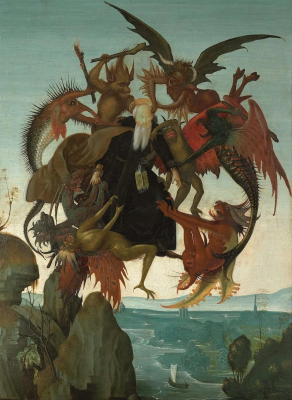
The Temptation of Saint Anthony by Michelangelo, 1486-1487 © Kimbell Art Museum, Fort Worth, Texas
Source: Christian Art
Gospel of 17 January 2026
Matthew 19:16-26
At that time: Behold, a man came up to Jesus, saying, 'Teacher, what good deed must I do to have eternal life?'
And he said to him, 'Why do you ask me about what is good? There is only one who is good. If you would enter life, keep the commandments.' He said to him, 'Which ones?' And Jesus said, 'You shall not murder; You shall not commit adultery; You shall not steal; You shall not bear false witness; Honour your father and mother, and, You shall love your neighbour as yourself.'
The young man said to him, 'All these I have kept. What do I still lack?' Jesus said to him, 'If you would be perfect, go, sell what you possess and give to the poor, and you will have treasure in heaven; and come, follow me.' When the young man heard this he went away sorrowful, for he had great possessions.
And Jesus said to his disciples, 'Truly, I say to you, only with difficulty will a rich person enter the kingdom of heaven. Again I tell you, it is easier for a camel to go through the eye of a needle than for a rich person to enter the kingdom of God.' When the disciples heard this, they were greatly astonished, saying, 'Who then can be saved?' But Jesus looked at them and said, 'With man this is impossible, but with God all things are possible.'
Reflection on the painting
Saint Antony Abbot, more widely known as Antony the Great, is venerated as the Father of Monasticism. Born around 251 AD in Upper Egypt into a well-off Christian family, he was deeply moved by the words of Jesus in the Gospel: "Go, sell what you have, give to the poor, and come follow me." Taking this literally, he gave away his inheritance and withdrew into the desert to live a life of prayer, solitude, and spiritual warfare. Antony became famous for his fierce battles against temptation, his long fasts, and his unwavering trust in God. He attracted disciples who sought to imitate his radical way of life, and though he never founded monasteries in a formal sense, his example laid the spiritual foundations for Christian monasticism. His life was written about by Saint Athanasius, and his biography spread across the Christian world, inspiring countless others, from the deserts of Syria to the cloisters of medieval Europe.
One of the most well know paintings depicting the saint, is Michelangelo's The Torment of Saint Anthony. In fact, it is one of the very few paintings firmly attributed to him, and remarkably, he created it as a young teenager, around 1487-1488. He was only 12-13 years old! The work is based on a famous engraving by the German artist Martin Schongauer, depicting an episode from the life of Saint Antony the Great in which desert demons physically lift the saint into the air and torment him with bizarre, grotesque forms. Michelangelo, already showing the brilliance that would define his career, adapted Schongauer's composition but enhanced it with a deeper sense of three-dimensional anatomy, muscular tension, and vivid colour.
He studied fish and other creatures from life at the market to give the demons more convincing and unsettling detail. The painting captures Saint Antony's unwavering faith in the midst of spiritual assault. While monstrous beings pull, scratch, and batter him, his expression remains calm and focused on God, a visual testimony to inner strength against temptation.
LINKS
Gospel in Art: https://christian.art/
Today's Reflection: https://christian.art/daily-gospel-reading/matthew-19-16-26-2026/
 Facebook
 Twitter
 LinkedIn
 Print
Print Email
Email










 Facebook
 Twitter
 YouTube
 LinkedIn
 Pinterest