


Fra Angelico in Florence: Painter of miracles
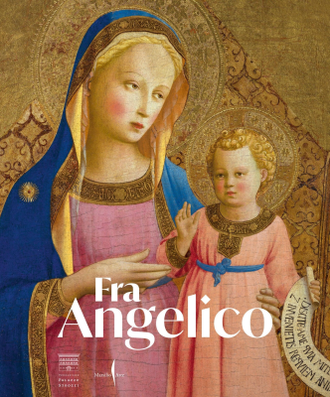
Official Poster
If you live in or love Italy, if you have a few hours or days to spare, you have just 12 days to get to Firenze/Florence to see one of the most superlative art exhibitions of this or any other century. The New York Times headlined it, 'Fra Angelico and the Miracle of Faith made visible.' It comprises more than 140 religious works of art from the 15th century as the Middle Ages made way for the Renaissance.
Small and large miracles abound in the exhibition, which took more than four years in the planning, and shows off masterpieces of painting, drawing, sculpture and illuminated manuscripts from leading institutions such as the Louvre in Paris, the Gemäldegalerie in Berlin, the New York Metropolitan Museum of Art, the National Gallery of Art in Washington DC, the Vatican Museums, the Alte Pinakothek in Munich, the Rijksmuseum in Amsterdam, the Uffizi, and numerous libraries, churches, and collections in Italy and internationally..
Collecting art from so many places was an achievement in itself, especially since the works include seven altarpieces whose panels were dispersed far and wide, thanks to Napoleon's confiscation of the art of Italy's religious orders.
The exhibition is centred on Fra Angelico -- the Angelic Friar -- born Guido di Pietro in the late 15th century, who became a Dominican friar, Giovanni da Fiesole; but it shows his development and influence in relation to painters such as Lorenzo Monaco, Masaccio, and Filippo Lippi, as well as sculptors like Lorenzo Ghiberti, Michelozzo and Luca della Robbia.The works are on display in two venues: the majority are in the Palazzo Strozzi; but the Museo di San Marco also has an important contribution that includes frescoes that Fra Angelico painted. His stunning simple Annunciation with an angel with rainbow wings is at the top of the stairs leading to more than 40 individual cells of the original convent, which all have their own frescoes by Fra Angelico. Palazzo Strozzi is more generous in displaying its works, being open every day from 10.00 to 20.00 and to 23.00 on Thursdays; whereas the Museo di San Marco, befitting a government institution, opens its doors from a few seconds before 08.30 until 13.50 and is closed on Mondays.
This is extraordinary religious art, without any of the doubts or heresies of our later times. Christ, Mary and all the saints. with a preference for St Dominic to whose order Fra Angelico belonged, all wear perfectly formed shining golden haloes. The themes, the Annunciation, Nativity, Agony in the Garden, Crucifixion, Resurrection, Crowning of Mary surrounded by saints, follow the mysteries of the rosary. There is also a powerful Last Judgement to remind us of the connections between life, death and eternal life or damnation.
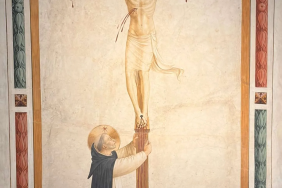
Giorgio Vasari in his 1550 book The Lives of the Artists wrote about Fra Angelico: "he lived chastely, withdrawn from the snares of the world... Fra Angelico would never take up his brushes without a prayer. Whenever he painted a Crucifixion, the tears would stream down his face." John Ruskin declared that Fra Angelico was "not an artist, properly so-called, but an inspired saint." And indeed, Fra Angelico was beatified in 1982; when Pope John Paul was asked about the miracles attributed to Fra Angelico, he pointed to the paintings, declaring, "These are his miracles." The English version of the catalogue is entitled "Fra Angelico"; whereas the Italian catalogue is "Beato Angelico".
But Fra Angelico was worldly enough to enjoy the patronage of Cosimo de Medici, founder of the clan that dominated Florentine politics during the Renaissance. Cosimo kept a cell for himself at the friary so that he might "retreat from the world", and he commissioned Fra Angelico to paint the frescoes in San Marco.
The works in the exhibition also show Angelico leading the way to the Renaissance. He ventured a new style, called Sacra Conversazione, later taken up by Bellini, Titian and Raphael. In the previously conventional style, depictions of the Madonna and child and saints were statically ethereal, as if in an untouchable place in Heaven. Fra Angelico's saints are grouped as if in normal life enjoying a conversation. The San Marco altarpiece is a good example of sacra conversazione, and it also shows Fra Angelico's use of perspective and trompe-l'oeil.
Fra Angelico's works are brilliantly beautiful, carefully and meticulously painted individually. Collectively they are overwhelming, particularly in the bright gold and stunning lapis lazuli colours of the restored works that after an hour, I needed to sit down, close my eyes and reflect on their eternal messages, and then make one more tour.
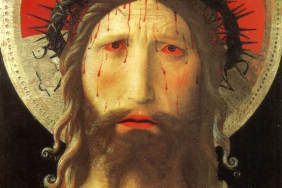
To me, the abiding memory is the immense affection and love of the figures, especially of the Virgin and child, and the tenderness in the expressions of the utterly spent Christ and his mother who receives his body. I have to close my eyes again and reflect how different Fra Angelico's depiction of the Christian story and message is from the bustle of the real world outside the exhibition doors. Cup final sized crowds rush from every direction celebrating the New Year -- while in the New York Times, President Donald Trump and his apparatchiks are boasting that brutal naked power rules the world, and whatever Trump decides is moral is the guiding light for use of that power.
Fra Angelico at Palazzo Strozzi and Museo di San Marco until 25 January 2026
LINKS
Fra Angelico at Palazzo Stozzi: www.palazzostrozzi.org/en/archivio/exhibitions/angelico/
Fra Angelico at Museo di San Marco: https://museitoscana.cultura.gov.it/news/beato-angelico-una-straordinaria-mostra-dedicata-a-fra-giovanni-da-fiesole-detto-beato-angelico/
See a short video of the exhibitions: www.youtube.com/watch?v=sYqCTwsXhws
 Facebook
 Twitter
 LinkedIn
 Print
Print Email
Email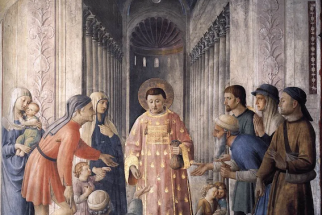









 Facebook
 Twitter
 YouTube
 LinkedIn
 Pinterest