

Turkiye: Pope prays with Ecumenical Patriarch, signs Joint Declaration
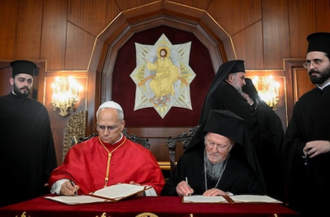
Signing the Joint Declaration
Source: Vatican Media
After his visit to the Blue Mosque in Istanbul on Saturday, Pope Leo addressed the faithful at the Patriarchal Church of Saint George in a prayer service and Doxology.
In his greeting to the Ecumenical Patriarch of Constantinople, Bartholomew I, the Pope expressed his heartfelt gratitude for the warm reception, highlighting the continuity of fraternal bonds with his predecessors.
"Upon entering this Church," Pope Leo XIV said, "I experienced great emotion, mindful that I am following in the footsteps of Pope Paul VI, Pope John Paul II, Pope Benedict XVI, and Pope Francis. I am also aware that Your All Holiness had the opportunity to meet my venerable predecessors personally, and to develop a sincere and fraternal friendship with them based on shared faith and a common vision of the challenges facing the Church and the world."
The Pope reflected on the deepening of his own friendship with the Ecumenical Patriarch, recalling their first meeting at the start of his ministry as Bishop of Rome.
Central to the pilgrimage was the commemoration of the First Council of Nicaea, an event that laid the foundations of Christian unity.
"Yesterday, and again this morning, we experienced extraordinary moments of grace as we commemorated, together with our brothers and sisters in faith, the 1,700th anniversary of the First Ecumenical Council of Nicaea," the Pope said.
He emphasized that the memory of the Council, inspired by the prayer of Jesus that "all His disciples may be one" (cf. Jn 17:21), encourages a renewed commitment to restore full communion among all Christians.
Pope Leo XIV also paid homage to the Apostle Andrew, patron saint of the Ecumenical Patriarchate.
Concluding his greeting, the Pope extended his "most fervent good wishes" to the Patriarch and all present in celebration of the feast of their patron saint on Sunday, underscoring the shared journey of faith that unites the Catholic Church and the Ecumenical Patriarchate.
Before a private meeting, the Pope and the Patriarch signed a Joint Declaration reaffirming their shared commitment to the path toward restored full communion and their united rejection of any appeal to religion to legitimize violence.
"The goal of Christian unity," the Declaration states, "includes the objective of contributing in a fundamental and life-giving manner to peace among all peoples. Together we fervently raise our voices in invoking God's gift of peace upon our world."
Noting that "tragically, in many regions of our world, conflict and violence continue to destroy the lives of so many," the Pope and the Patriarch issued an appeal "to those who have civil and political responsibilities to do everything possible to ensure that the tragedy of war ceases immediately, and we ask all people of good will to support our entreaty."
The encounter between the two leaders took place on the eve of the Feast of Saint Andrew, the First-Called Apostle and patron of the Ecumenical Patriarchate.
Opening their declaration with the words of the Psalmist, "O give thanks to the Lord, for he is good, for his steadfast love endures forever," the Pope and the Patriarch express gratitude for the grace of a fraternal meeting rooted in ecclesial charity and fidelity to the will of Christ.
Pope Leo and Patriarch Bartholomew recall that the search for full communion is grounded not in human diplomacy but in obedience to the Lord's prayer in the Gospel of John: "that they may all be one… so that the world may believe."
They affirm their determination to continue walking together "in love and truth," inviting all the faithful-clergy, monastics, consecrated persons, and laypeople-to pray and work for the fulfillment of this divine petition.
The Declaration reflects on the 1,700th anniversary of the First Ecumenical Council of Nicaea, commemorated the day before.
In it, the two leaders describe Nicaea as "a providential event of unity," noting that its importance lies not only in historical memory but in ongoing openness to the Holy Spirit who guided the Council.
They state that Christians are bound together by the faith confessed in the Nicene Creed: the confession of Jesus Christ, "true God from true God, homoousios with the Father," who became incarnate for our salvation, died and rose again, ascended into heaven, and will come in glory to judge the living and the dead.
This shared reception of the Creed, they write, allows the Churches to confront common challenges "with mutual respect… and genuine hope."
"Endowed with this common confession, we can face our shared challenges in bearing witness to the faith expressed at Nicaea with mutual respect, and work together towards concrete solutions with genuine hope."
Expressing gratitude that this year all Christians celebrated Easter on the same day, Pope Leo XIV and Patriarch Bartholomew I describe this as a gift of divine providence.
They renew their willingness to continue the discernment already underway "for celebrating together the Feast of Feasts every year," praying that all Christians may be guided "in all wisdom and spiritual understanding."
The declaration also highlights the 60th anniversary of the 1965 Joint Declaration of Pope Paul VI and Ecumenical Patriarch Athenagoras, which removed the exchange of excommunications of 1054.
The Pope and the Patriarch give thanks for that decisive gesture, which opened the path to dialogue rooted in "trust, esteem and mutual charity."
They encourage those still hesitant about dialogue to listen attentively to the Holy Spirit, who urges Christians to offer to the world a renewed witness of reconciliation.
Reaffirming their support for the Joint International Commission for Theological Dialogue between the Roman Catholic Church and the Orthodox Church, the two leaders note that its current phase examines issues that have historically been regarded as divisive.
They commend theological dialogue, fraternal contacts, common prayer, and cooperation in areas where joint initiatives are already possible, encouraging all the faithful to welcome the progress made so far and to "labour for [its] continued increase."
A central theme of the text is the ethical and spiritual imperative to reject the misuse of religion.
"We reject any use of religion and the name of God to justify violence," the Pope and the Patriarch write, raising their voices together in an appeal for peace amid ongoing conflicts.
They urge civil and political leaders to do everything possible to bring an end to war, and call upon all people of goodwill to support efforts for peace.
Authentic interreligious dialogue, they insist, is not a source of confusion but "essential for the coexistence of peoples of different traditions and cultures."
Recalling the 60th anniversary of Nostra Aetate, they exhort all persons to collaborate in building a just and supportive world and in caring for creation, resisting "indifference, desire for domination, greed for profit, and xenophobia."
Despite the gravity of world events, the declaration expresses unwavering Christian hope. "God will not abandon humanity… By the Holy Spirit, we know and experience that God is with us," they affirm.
Entrusting every person-especially those suffering hunger, loneliness, or illness-to the mercy of God, they invoke the grace that "their hearts may be encouraged, as they are knit together in love."
Read the full text of the Joint Declaration: www.vatican.va/content/leo-xiv/en/travels/2025/documents/20251129-dichiarazione-congiunta.html
Watch highlights of the meeting here: www.youtube.com/watch?v=ySdquCQvZYc
 Facebook
 Twitter
 LinkedIn
 Print
Print Email
Email













 Facebook
 Twitter
 YouTube
 LinkedIn
 Pinterest