


As COP30 meets in Brazil, 62 faith institutions announce fossil fuel divestment
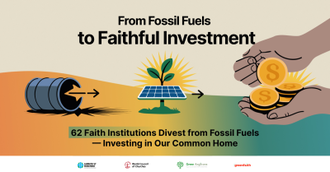
Credit: Laudato Si Movement
Source: Laudato Si' Movement
In one of the biggest divestment announcements to date, dozens of faith institutions have demonstrated climate leadership and accelerated the transition to a fossil free future.
On 18 November 2025, 62 faith institutions announced their divestment from fossil fuel companies, sending a strong signal to negotiators at the UN climate summit in Brazil on the urgent need for fossil fuel phase out, given the harmful climate, biodiversity and human rights impacts of extracting, transporting and burning fossil fuels.
Today's list of divesting institutions includes five Catholic dioceses (four in Italy and one in Canada), Catholic religious orders in France, Belgium, Germany, Austria, Switzerland, the Netherlands, the UK and the US; Catholic and Protestant banks in Germany; and 42 members of the Arbeitskreis Kirchlicher Investoren (AKI), a network of institutional investors in the German Protestant Church.
For the first time, a Catholic diocese in Canada has announced its divestment from fossil fuel companies. Its decision is especially significant as Canada - with the US, Australia and Norway - is among those most responsible for fossil fuel expansion since the Paris Agreement. Together, these four countries increased fossil fuel production by nearly 40% between 2015 and 2024, while production in the rest of the world combined fell by 2% during the same period.
In Italy, which has been hit by extreme heat, wildfires and floods in recent months, the calls for divestment from numerous Catholic bishops and the Community of the Diaconate are especially significant. They provide clear evidence of the strong support for fossil fuel phase out within the Catholic Church in Italy.
In the Catholic Church, the Jesuit Central European Province (covering Germany, Austria, Switzerland, Lithuania and Latvia), Pax-Bank für Kirche und Caritas and Steyler Bank have announced full divestment from fossil fuel companies.
During his address last month at the 'Raising Hope' Conference in Italy, Pope Leo XIV renewed his call for courageous and coordinated climate action, urging institutions and citizens alike to take responsibility for shaping a just future. "Everyone in society, through non-governmental organizations and advocacy groups, must put pressure on governments to develop and implement more rigorous regulations, procedures and controls."
His words echoed the strong call from Church leaders across the Global South. In July, Catholic bishops from Africa, Asia, Latin America, and the Caribbean issued a joint appeal ahead of COP30, urging an end to fossil fuels and transformative action grounded in dignity, solidarity, and justice. "Abandoning fossil fuels is not only necessary to reduce emissions, but also to repair an ecological and moral debt to the Global South," they stated.
Globally, more than 1,700 institutions, with combined assets of over $40 trillion, have made some form of fossil fuel divestment commitment. Faith groups have led the way, with more than 600 faith institutions around the world divesting. Religious institutions manage a combined $3 trillion of investments globally. As well as divesting from fossil fuels, faith communities are calling on governments and banks to phase out their support for fossil fuels and to scale up investment in clean energy. More than 600 faith institutions have supported calls for a Fossil Fuel Non-Proliferation Treaty.
Faith institutions ending fossil fuel investments send a strong signal to national governments at COP30, the UN climate negotiations in Brazil. While the Nationally Determined Contributions (NDCs) pledged by global governments continue to fall short, people of faith across the world are taking action through the People's Determined Contributions (PDCs).
The leadership of faith groups adds to the growing calls to bring an end to the fossil fuel era, in contrast to the actions of major oil and gas companies. In recent weeks, a Paris court has ruled that French oil giant TotalEnergies misled consumers by claiming to be a "major player in the energy transition", while continuing to produce more fossil fuels. Total is building the vast East Africa Crude Oil Pipeline (EACOP) across Uganda and Tanzania, which would worsen the climate emergency, endanger vulnerable communities and cause significant harm to ecosystems. The company has also faced criticism over its decision to restart the controversial Mozambique LNG project, despite the Netherlands launching an investigation into a massacre at the Mozambique gas plant.
A new report from Urgewald has shown that the fossil fuel industry is planning 33% more short-term expansion than in 2021, the year in which the International Energy Agency (IEA) stated that no new oil and gas fields are necessary to meet demand in a 1.5°C world. The report highlights ExxonMobil, Chevron, CNPC and Petrobras plans to drill for oil and gas in an ecologically sensitive area of the Amazon River, after permission was recently granted by the Brazilian government.
 Facebook
 Twitter
 LinkedIn
 Print
Print Email
Email










 Facebook
 Twitter
 YouTube
 LinkedIn
 Pinterest