

CARJ AGM: God's heart has a special place for the marginalised and excluded'
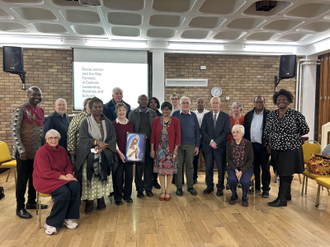
CARJ gathering at St Thomas More's ICN/JS
Deacon Justin Malawezi Jr, Senior Lecturer and Chaplain at Edge Hill University, Liverpool, was keynote speaker at the Catholic Association for Racial Justice (CARJ) Annual General Meeting, held at St Thomas More church in Manor House north London, on Saturday.
The day began with Yogi Sutton, Chair, outlined the current situation with CARJ. A serious reduction in funds led to having to make their Administrator redundant earlier this year, and CARJ are needing to consider their way forward. Since the Bishops' Conference took over responsibility for Racial Justice Sunday some years ago, collections have no longer come to CARJ but have largely been channelled through CSAN (Caritas Social Action Network) mainly for projects for refugees.
On a more positive note, CARJ has been invited to meet with representatives of the Bishops' Conference to set the theme for Racial Justice Sunday 2026 and to discuss how to advance racial justice in the Church.
Fr Phil Sumner was adopted as Vice-Chair and Deacon Justin Malawezi Jr as Treasurer.
Before lunch, ( a delicious spread prepared by parishioners) there was Mass in the parish church, where parish priest Fr Clive Lee spoke about the diversity of the parish and the positive contribution this had brought to the life of the community.
In the afternoon, Deacon Justin Malawezi Jr, gave an inspiring presentation based on work he is doing in Liverpool Archdiocese: 'Racial Justice and the Way Forward in Catholic Leadership, Parishes and Schools.'
Using the image of finding himself walking in the wrong direction on a travelator, on a long corridor in an airport, he saw: "Active, overt racism as walking along the travelator to get to the end faster.. Denying the reality of racism as allowing oneself to be carried to the end.." and "Active anti-racism as turning round and walking frantically against the direction of the travelator."
Speaking of his own experience of racism, he described how he used to hang the flag of his home country, Malawi, alongside the flag of the UK which is now his home; but having been intimidated in his neighbourhood by a Land Rover flying four St George's flags driving close to him - what he had seen as a symbol of pride now became a symbol of fear.
Deacon Justin said he was encouraged, however, by the teaching of the Church: 'God's heart has a special place for the marginalised and excluded' (Evangelii Gaudiam) and he asked 'How can the Church listen to those marginalised and excluded by systemic racism?'"
In Liverpool Archdiocese, he described how a meeting had been held to listen to people's experience of racism and look at how to make parishes more welcoming.
He then outlined his Schools Project, quoting the Final Document of the Synod 'Structures of sin shape the way people think and act.' (53)
Justin, who is also an artist, has created a series of booklets for children dealing with issues of racism - a wonderful resource for schoolteachers!) At the end of the course the school gets a certificate and a badge. He would like to scale up this project.
He has also painted a beautiful picture of an African Our Lady and offers one to each school to display in a prominent place. He would like to see one in every Catholic school in England and Wales.
He then looked at the barriers that exist to racial inclusion in Church leadership positions. He proposed have Racial Justice Representatives in every parish and asked: How can they be effective in their parishes and schools?
How could one Catholic walking together with 15 other Catholics influence them to bring about change in racial justice in the Church in England and Wales?
Feedback from group discussions pointed to: examining leadership roles in parishes (some questioned whether black people are often helpers but never the leaders?); how people are welcomed into parishes and encouraged to participate; the importance of networking between concerned people in a diocese who can then present coherent, concrete proposals to their bishop. The urgency of this in the context of rising racism in our society was stressed. However, a barrier to action at parish level is often the lack of co-operation by the parish priest; this where having Parish Representatives can be a help in ensuring that information gets through and issues raised.
It was pointed out that it is also important to distinguish between racism and issues facing refugees which is where the Church has tended to focus.
Christine Allen from CAFOD was invited to share how CAFOD has integrated anti-racism into all their structures, procedures and projects. Having been challenged by the death of George Floyd and the ensuing Black Lives Matter movement consulted with all involved in the organisation. She pointed out that organisations (and that includes parishes) need to be intentional about being anti-racist, to commit resources and to integrate anti-racism through all aspects and levels of the organisation.
LINKS
Deacon Malawezi's online booklets for children: https://malewezi.com/
CARJ: www.csan.org.uk/member/carj/
CAFOD: https://cafod.org.uk/
St Thomas More's parish, Manor House: https://cafod.org.uk/
 Facebook
 Twitter
 LinkedIn
 Print
Print Email
Email






 Facebook
 Twitter
 YouTube
 LinkedIn
 Pinterest