


An all-out war in the West Bank?
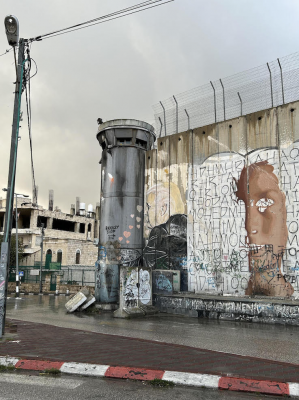
Separation Wall. Image ICN/JS
Toine van Teeffelen, Pax Christi partner at the Arab Education Institute in Bethlehem writes:
Yesterday, our family was momentarily uncertain about whether there was a general strike in the West Bank today and whether Mary needed to stay away from work at the university. At least 45 people were killed after an Israeli airstrike in Rafah, in response to rockets fired by Hamas at Tel Aviv. Clusters of tents housing displaced people were hit in what was supposed to be a "humanitarian area," a safe zone. The Israeli military said its air force struck a Hamas compound with "precise ammunition and based on precise intelligence." What precision? Many refugees remained trapped for hours due to a large fire in tents destroyed by the bombardment.
While there was a strike at Birzeit University, Mary had to go to work in the end; after all, there are massacres almost every day.
This past week, I noticed a Haaretz article by former Israeli prime minister Ehud Olmert, in which he paints an apocalyptic scenario for the West Bank, or, in Israeli terminology, "Judea and Samaria."
He says that alongside Gaza, to which he doesn't give much attention, "at the same time, with barely anyone noticing, a war is developing that threatens to overshadow all the tragedy, blood, and destruction in Gaza. With the support of the government of Israel, with its backing and support, sometimes active and sometimes passive, a battle is being waged in Judea and Samaria that may well spark a war aimed at expelling the millions of Palestinians living there. That is the heart of the matter. It is impossible to understand the events in Judea and Samaria except as part of an effort intended at the end of the day to ignite a fire that will spread across all of Israel and lead to an all-out war." (Emphasis added, TvT).
Quite a prediction: the expulsion of all Palestinians from the West Bank in an all-out war which will overshadow Gaza.
Olmert: "I have said it before and I will say it again: The war in the Gaza Strip is not really the heart's desire of Itamar Ben-Gvir and Bezalel Smotrich [two central ministers in the Israeli government belonging to extreme parties, TvT] and their friends. Their calls for the conquest of Rafah are secondary to the war in the West Bank. Rafah is in their mouths while Judea and Samaria are in their hearts."
What kind of war, and between whom? We know that on the Israeli side, it involves the active or passive cooperation between settlers and the army, complicit in chasing away dozens of semi-Bedouin communities in so-called areas C of the West Bank under direct Israeli military control. The aim is to free land for Israeli settlements and outposts.
We also know about new settlement plans around Jerusalem, in the Jordan Valley, and other places. According to the latest news from Peace Now, a new settlement drive is expected in the very north of the West Bank.
But, again, millions of Palestinians on the flight? One would think that only a war with rockets and bombardments like in Gaza would bring about such a situation in the West Bank. (But it is difficult to believe in such a case that the Israeli settlements would remain out of the fire range).
I assume Olmert envisions a different scenario. Something like a staged approach: first a drastic overall weakening of Palestinian society in the West Bank, followed by likely political radicalization and heavy military repression; further destabilization, anger, and fear, leading to an exodus of Palestinians.
The weakening of society is already happening. We know about military operations, especially in the north of the West Bank - Jenin, Tulkarem, and their refugee camps - where dozens of Palestinian lives have been lost in raids against what Israel says are mainly Hamas operatives. One area there is called: "mini-Gaza."
The collapse of the Palestinian economy will in the coming time be a major contributing factor to the weakening of the society. According to the World Bank, almost half a million jobs have been lost in the Palestinian economy since October last year. This includes an estimated loss of 200,000 jobs in the Gaza Strip, 144,000 jobs in the West Bank, and 148,000 laborers from the West Bank working in the Israeli labor market, as Jerusalem and Israel are closed off to West Bankers.
The Palestinian Authority is in a heavy fiscal crisis. Its financial deficit reached $682 million in 2023, but it is expected to double within the coming months to reach up to $1.2 billion. In addition, Israel is threatening on July 1 to cut off Palestinian banks from their Israeli correspondent banks.
US Treasury Secretary Yellen: "These banking channels are critical for processing transactions that enable almost $8 billion a year in imports from Israel, including electricity, water, fuel, and food, as well as facilitating almost $2 billion a year in exports on which Palestinian livelihoods depend." Moreover: "Israel's withholding of revenues that it collects on behalf of the Palestinian Authority also threatens economic stability in the West Bank."
There is another important element of this scenario of weakening and ensuing destabilization: the fragmentation of the West Bank urban areas, which are in the process of becoming economic and social islands.
It is not for pleasure that you go from one city to another, only when it is absolutely necessary for work or study. It is not just a matter of delays.
A few weeks ago, Mary and I went to Ramallah for the renewal of my passport. At the so-called container checkpoint halfway to the east of Jerusalem, we saw on the way back to Bethlehem a young man with his shirt taken off standing in front of a wall. In a casual voice, a young man from Beit Sahour sitting in our shared taxi said that during a previous trip his friend was beaten on his arm, another friend on his legs, and still another on his feet.
Yesterday we saw on the Palestinian broadcaster Ma'an in the daily subtitling of regular local news that in the Etzion prison, next to the civil headquarters of the army in the southern West Bank, "torture takes place on Wednesdays and Saturdays." Torture spread out over the week; as if for sale on special weekdays.
The trigger for Olmert's flashpoint is, I think, absolute despair, and ensuing radicalization and destabilization not just of the economy but of society as a whole.
In turn, Israeli spokespersons speak not about a Palestinian but an Israeli struggle for survival. Another former Israeli prime minister, Naftali Bennett, spoke recently about Israel as a "Sparta" - the ancient Greek bastion engaged in a continuous military struggle for survival.
In his vision of Israel, this was not entirely negative. Under the circumstances, Israel needs to become like that, he said. He spoke about Israel as an apparently not wholly unattractive "Silicon Valley in Sparta." A kind of frontier of the western civilized world fighting terror, a testing place of high-tech weaponry and related equipment. What better place to live?
LINKS
See for my new book about Bethlehem: https://sumudblog.wordpress.com/book/
Sources:
https://twitter.com/naftalibennett/status/1777500022457745696
 Facebook
 Twitter
 LinkedIn
 Print
Print Email
Email

















 Facebook
 Twitter
 YouTube
 LinkedIn
 Pinterest