

Sunday Reflection with Fr Robin Gibbons: 16 January 2022
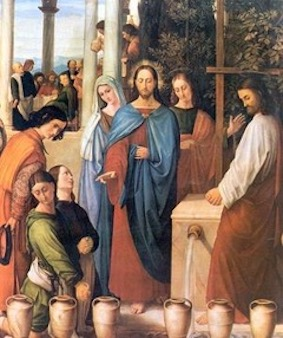
--------- The Wedding at Cana --------- Julius Schnorr Von Carolsfeld - 1818
First Sunday in Ordinary Time
One of the most helpful insights I was given, and I've heard it said elsewhere, is that we need to treat the scriptures a little like a detective plot, as though we are a mini Miss Marple, Poirot, Fr Brown or Maigret. In other words we are not to isolate sections from the whole, instead look for other things that run through the text in order to connect themes and insights. We also have to take account of the necessary Christian desire to make the prophecy found in the OT come alive in the mission and life of Jesus. This has been enormously helpful, not only to help me in grappling with some of the stories in the NT, but also in making me return ,again and again to that tradition I was taught as a Benedictine, of proper Lectio Divina, letting the scriptures become part of my everyday life, ruminating on the passages, and so let the Spirit and the Word speak to me through them.
So first things first, I am not a scripture scholar, but I am a scholar who loves scripture, more than that I am a priest who tries to share the living word in ministry, preaching and life. So, as we reflect on the story of the Miracle at Cana, what can we find to assist us in the situations of our life in the world of each day as it is now? I think we have to take the account as a given and in it recognise that this is an actual event, and it is also John showing us the manifestation of Jesus divinity, as in those great feasts we have just celebrated, this first miracle is not only a sign of who he really is, but a true theophany, and as with the others understood only by very few at the point of happening, but of immense significance to those who like us, later come to believe in Jesus as true God made flesh on this earth, we are the ones who see his glory!
What I am thinking of when I reflect on the story of the miracle of Cana, a story unique to John. Yes, it's a sign of the divine nature of Jesus, but it's also a tale of our journey to its ending in the Kingdom of heaven, and also of an insight into the role of Mary his mother as well. Pick up that simple phrase which begins the story:' On the third day there was a wedding* in Cana* in Galilee, and the mother of Jesus was there. Jesus and his disciples were also invited to the wedding' (Jn 2:1,2) The mention of a third day should immediately help us resonate with other mentions of that in the Scriptures, for the third day is an allusion to a 'Theophany' of God, only here as with the Magi and the Baptism, we see the manifestation of the Unseen One in the person of Jesus the Christ.
The mention of the Mother of Jesus before the others is no isolated comment, it points to a role she has that is important for our meditation on this passage as the one who helps reveal it to others. But do ignore the supposed harshness of his answer to her comment. When the wine ran short, the mother of Jesus said to him, "They have no wine." '(Jn 2:3) it is not meant like that, it is probably a very formal and respectful way of speaking, instead let us allow other images to filter the scene, for Mary's presence there might indicate that this wedding was of somebody known to her, maybe even of family connection which makes her concern the more poignant and her need of Jesus to become part of the revelation of who he really is.
What then for us? We know the greater miracle than Cana, where we too are given the new wine of the marriage feast of heaven, shared out in the celebration of the Eucharist. There is more, this miracle reveals the glory of Jesus and opens faith in him, for as St John reminds us we too have seen his glory, and as we gather to celebrate the Eucharist as at a wedding feast, we find he is there present when we come together in his name, not only the wine is changed, but our lives are as well.
Lectio Divina
From a Sermon by Fr Thomas Keating OCSO on the wedding feast at Cana
The miracle implies that the new wine that Jesus provides will never run out. It is also a new creation. The old creation, with its burden of sin is erased, and the new creation, the action of the Spirit, is now available. The new creation is the kingdom of God. And what is the entrance fee? Only the consent of faith. The inherent energy of this wine, strong because it comes from God, will enable us, little by little, to overcome our compulsions, addictions, and sinfulness. Having become one with us in our fallen human nature, Jesus transforms our fallen nature into his divinity.
.Richard Crashaw - Divine Epigrams:
To Our Lord upon Water Turned into Wine
Thou water turn'st to wine, fair friend of life,
Thy foe, to cross the sweet arts of thy reign,
Distils from thence the tears of wrath and strife,
And so turns wine to water back again.
St John Paul II - Redemptoris Mater
At Cana in Galilee there is shown only one concrete aspect of human need, apparently a small one and of little importance (they had no wine), but it has a symbolic value. This coming to the aid of human needs means at the same time bringing those needs within the radius of Christ's messianic mission and salvific power. Thus there is a mediation. Mary places herself between her Son and mankind in the reality of their wants, needs and sufferings.
 Facebook
 Twitter
 LinkedIn
 Print
Print Email
Email










 Facebook
 Twitter
 YouTube
 LinkedIn
 Pinterest