

Sunday Reflection with Fr Robin Gibbons - 7 November 2021
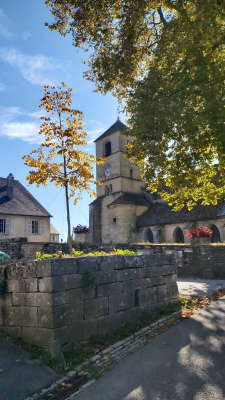
Abbatiale Chateau Chalon Jura - Image RG
In such an age as we live in, the power of the media in its many forms is immense, it allows us to examine issues but it also helps form opinion, not always necessarily for the good of others, so in public life those who are able need to be robust guardians of the truth and ask for strong critique of key ideas and statements especially in politics. The current focus by Cop 26 on Climate Change and the future of our planet is one area where it is absolutely imperative that clear rational and scientific language be used to detail the immense peril many parts of our world face now. Pope Francis and the Ecumenical Patriarch Bartholomew as well as the Dalai Lama have been, and are, clear religious voices adding another dimension to the debate, not about whether climate change is real, but what we need to do in order to achieve suggested ways of change, their prophetic voice is much like that of Elijah to the widow in our first reading, reminding us that God does not abandon us, but that by doing small things well, by offering the hospitality of care to those who live with us or who , like wildlife, domestic creatures and the world of nature in its fullness, are very much part of our concern. Each and every one of us has a part to play in the interconnected dimensions of our world now, and in the future. This means we can critique and change by playing our small part, actions go alongside words!
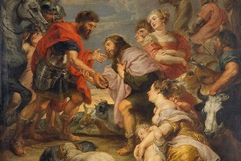
In the first reading, Elijah is asking for hospitality, but brings the blessing of the Most High upon the widow and life for her son, for carrying out one of the great commandments towards him, even in her situation of distress and desperate poverty. Turn the image onto ourselves, if this response from Elijah's God is true sign of how God responds to the destitute, a gift to those, who in the name of the Most High give of their love, how much more is it incumbent upon us, who follow the Christ, Word en-fleshed, to go much further?
The psalmist in our Responsorial Psalm (147) captures our vocation of care which is illustrated and exemplified by the Lord's own doings, the acts by which we are all called to ministry, let us reflect on these words:
'The LORD keeps faith forever,
secures justice for the oppressed,
gives food to the hungry.
The LORD sets captives free.
The LORD gives sight to the blind.
The LORD raises up those who were bowed down;
the LORD loves the just.
The LORD protects strangers.' (Ps 147)
All this is the LORD's own doing, but we people of the New Covenant in Christ are called to carry out these acts on behalf of the Holy `One, in our world, amongst neighbour, friend, stranger, wherever we are in whatever way we can. We are called to keep faith, we are enabled to be set on justice, we must free those imprisoned in so many ways, we are to help others see the right way and to go forward. In fact loving hospitality, that second part of the great commandment ( to love our neighbour) is what we do each hour, each day, each month, each year, not when we feel like it. In this way we too are helping the metanoia of our human companions in a world that badly needs our generosity, sacrifice and love, for though wounded, it is a sacred place, already part of the Kingdom, yet to be manifest in all fullness.
Let's go a little deeper, the Letter to the Hebrews ought to shake us a bit, so read it very carefully and notice these things which cement the reason for our calling. Christ was made manifest in this world to do this, says the writer, to 'annul' sin, causing its total destruction and to counteract all its effects. He does this 'through His sacrifice', and by the New Covenant made once and for all. Though we die to judgement Christ having died once is to come again in glory. I like this phrase, though I am not quite sure where it came from "We die once, and the next thing before us is judgment. So Christ died once and the next thing before Him is the Advent".
This is a deep and potent hope at the heart of our faith which can help us move out of gloom and doom to be proactive for change, seeing it as part of an unfurling of the continued love God has for this little world of ours. As Jesus points out in his story of the total giving of the widow in the Gospel:
"A poor widow also came and put in two small coins worth a few cents. Calling his disciples to himself, he said to them, "Amen, I say to you, this poor widow put in more than all the other contributors to the treasury. For they have all contributed from their surplus wealth, but she, from her poverty, has contributed all she had, her whole livelihood."(Mk 12:42-44)
This ought to give each of us hope, for hidden in the clouds of gas emissions, the deforestation, pollution, and political wrangles, we also 'see salvation'. Christ will come again in glory to make those who wait for Him, partakers of the great salvation and that includes our poor earth. Until that day we are called to live in the expectation of hope. Every small act or progressive love, like those two widows in our scriptures this Sunday calls us to get on with it, loving God and our neighbour will also become a concrete way of assisting in the work of care for our earthly home.
Lectio
St Basil the Great
from The Hexameron
"I want creation to penetrate you with so much admiration that everywhere, wherever you may be, the least plant may bring to you the clear remembrance of the Creator. If you see the grass of the fields, think of human nature, and remember the comparison of the wise Isaiah. "All flesh is grass, and all the goodliness thereof is as the flower of the field."
Poem
Lou Ella Hickman
Widow of Zarephath
Commonweal Magazine
May 16, 2014
I was like a small bird
pecking near a gate
when i went in search of twigs-
a bit of wood for a fire
so after one last meal
my son and i could die...
then a man asked for water-
a bit of bread
now i, a small bird,
found more than twigs
because i too, like ravens, fed him
Extract from:
Messaggio congiunto del Santo Padre Francesco, di Sua Santità Bartolomeo I, Patriarca Ecumenico di Costantinopoli, e di Sua Grazia Justin Welby, Arcivescovo di Canterbury, per la protezione del Creato, 07.09.2021
The Imperative of Cooperation
Over the course of the pandemic, we have learned how vulnerable we are. Our social systems frayed, and we found that we cannot control everything. We must acknowledge that the ways we use money and organise our societies have not benefited everyone. We find ourselves weak and anxious, submersed in a series of crises; health, environmental, food, economic and social, which are all deeply interconnected.
These crises present us with a choice. We are in a unique position either to address them with shortsightedness and profiteering or seize this as an opportunity for conversion and transformation. If we think of humanity as a family and work together towards a future based on the common good, we could find ourselves living in a very different world. Together we can share a vision for life where everyone flourishes. Together we can choose to act with love, justice and mercy. Together we can walk towards a fairer and fulfilling society with those who are most vulnerable at the centre.
But this involves making changes. Each of us, individually, must take responsibility for the ways we use our resources. This path requires an ever-closer collaboration among all churches in their commitment to care for creation. Together, as communities, churches, cities and nations, we must change route and discover new ways of working together to break down the traditional barriers between peoples, to stop competing for resources and start collaborating.
To those with more far-reaching responsibilities-heading administrations, running companies, employing people or investing funds-we say: choose people-centred profits; make short-term sacrifices to safeguard all our futures; become leaders in the transition to just and sustainable economies. 'To whom much is given, much is required.' (Lk 12:48)
This is the first time that the three of us feel compelled to address together the urgency of environmental sustainability, its impact on persistent poverty, and the importance of global cooperation. Together, on behalf of our communities, we appeal to the heart and mind of every Christian, every believer and every person of good will. We pray for our leaders who will gather in Glasgow to decide the future of our planet and its people. Again, we recall Scripture: 'choose life, so that you and your children may live' (Dt 30:19). Choosing life means making sacrifices and exercising self-restraint.
All of us-whoever and wherever we are-can play a part in changing our collective response to the unprecedented threat of climate change and environmental degradation.
Caring for God's creation is a spiritual commission requiring a response of commitment. This is a critical moment. Our children's future and the future of our common home depend on it.
 Facebook
 Twitter
 LinkedIn
 Print
Print Email
Email







 Facebook
 Twitter
 YouTube
 LinkedIn
 Pinterest