

Viewpoint from Trinidad and Tobago: Stop crime, not lives!

Leela Ramdeen
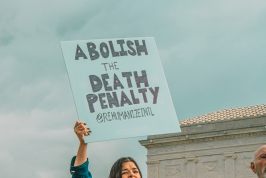
The 19th World Day Against the Death Penalty takes place on Sunday October 10th. The theme is: Women sentenced to death: An invisible reality.
In 2018 Pope Francis approved a revision of our Catholic Catechism (2267), making it clear that "the death penalty is inadmissible because it is an attack on the inviolability and dignity of the person, and she works with determination for its abolition worldwide."
In 2015, the Holy Father had written a letter to the International Commission Against the Death Penalty. In the letter, he called capital punishment "cruel, inhumane and degrading" and said it "does not bring justice to the victims, but only foments revenge."
"Furthermore, in a modern 'state of law, the death penalty represents a failure' because it obliges the state to kill in the name of justice, the pope had written. On the other hand, he said, it is a method frequently used by 'totalitarian regimes and fanatical groups' to do away with "political dissidents, minorities" and any other person deemed a threat to their power and to their goals.
"In addition, Pope Francis noted that "human justice is imperfect" and said the death penalty loses all legitimacy in penal systems where judicial error is possible."
A letter to all Bishops from the Prefect of the Congregation for the Doctrine of the Faith, Cardinal Luis Ladaria, dated 1 August 2018, includes the new text of the n. 2267 of the Catechism of the Catholic Church, as approved by Pope Francis.
The new Catholic Catechism text reads:
'The death penalty 2267. Recourse to the death penalty on the part of legitimate authority, following a fair trial, was long considered an appropriate response to the gravity of certain crimes and an acceptable, albeit extreme, means of safeguarding the common good.
'Today, however, there is an increasing awareness that the dignity of the person is not lost even after the commission of very serious crimes. In addition, a new understanding has emerged of the significance of penal sanctions imposed by the state. Lastly, more effective systems of detention have been developed, which ensure the due protection of citizens but, at the same time, do not definitively deprive the guilty of the possibility of redemption.
Consequently, the Church teaches, in the light of the Gospel, that 'the death penalty is inadmissible because it is an attack on the inviolability and dignity of the person', and she works with determination for its abolition worldwide.'
I am the Chair of CCSJ and of the Greater Caribbean for Life (GCL), an independent not-for-profit civil society organisation devoted to working towards the abolition of the death penalty in our region.
After the 59th anniversary of Trinidad and Tobago's (TT) Independence in August and the 45th commemoration of our Republic in September, let's reflect on whether, when we came of age, we carried some "Colonial baggage" that we should have jettisoned. I refer in particular to the "savings clause" in TT's Constitution.
The Caribbean Death Penalty Research states that "the savings clause is a general savings clause that saves all existing law from challenge including laws which are incompatible with the fundamental rights guarantee also in the Constitution...in the context of the death penalty debate, such clauses have made the fundamental rights guarantee in these constitutions unworkable, as the savings clauses protect from challenge all laws that were in existence on independence."
Lord Anthony Gifford QC rightly states that "the savings clauses are 'most objectionable', and have the effect of leaving the law 'frozen in the mould of the 1960s'. He urges that 'A living constitution must be capable of interpretation according to the developing standards of the day."
TT is the only country in the region that imposes the mandatory death penalty. TT's final Court of Appeal is the Judicial Committee of the Privy Council. Barbados' highest appellate Court is the Caribbean Court of Justice (CCJ). On 27 June 2018, the CCJ ruled in a particular case, that the mandatory death penalty, as stated in section 2 of the Offences Against the Persons Act (OAPA), Ch.141, for persons convicted of murder in Barbados, is unconstitutional.
The CCJ stated that savings clauses, which had 'saved' the mandatory death penalty in Barbados, should be condemned. Laws should not be "calcified to reflect the colonial times." These words uttered by Sir Dennis Byron, the then President of the CCJ, struck a chord with me. If we have come of age, why can't we shed the last vestiges of colonialism?
Today 144 countries, about two thirds of the countries in the world, have abolished the death penalty in law or practice. While we condemn the rise of violent crime in our region and express solidarity with victims, we reject the notion that capital punishment will act as a deterrent or foster respect for life in our communities.
Society has a right to protect itself from persons who commit heinous crimes and offenders must be held accountable. However, we believe that non-lethal means are sufficient to defend and protect society from offenders. We continue to address the symptoms of crime and not the root causes.
Let's act on recommendations such as those contained in the 2012 UNDP report: Human development and the shift to better citizen security e.g. by seeking to achieve a better balance between legitimate law enforcement and preventive measures, with a stronger focus on prevention, e.g. through youth development, education, job creation, addressing poverty and social exclusion. Let's strengthen family life and fix our broken institutions - including the re-engineering of the criminal justice system.
Archbishop Desmond Tutu rightly says: "There is no justice in killing in the name of justice and no godliness in exacting vengeance...It is our duty ...to break the dreadful cycle of violence and the doctrine of revenge...Universal abolition of the death penalty is not a pipe dream. It is a necessity."
Revenge will not help us to build peace or just societies. Let's use our human ingenuity to devise strategies that are more durable; more likely to effect the changes we wish to see. In 2918 Pope Francis revised n.2267 of the Catechism of the Catholic Church. He said: "The death penalty is inadmissible because it is an attack on the inviolability and dignity of the person, and she works with determination for its abolition worldwide."
Andrew Briggs was the last person to be hanged in TT - July 28 1999. The last person hanged in the English speaking Caribbean was Charles la Place, St Kitts - 19 Dec 2008. Following the restrictions contained in rulings in a number of Privy Council (JCPC) cases, it is now very difficult for these countries to implement the death penalty. Yet some, including TT, continue to sentence persons to death.
Let's stop crime, not lives!
 Facebook
 Twitter
 LinkedIn
 Print
 Email









 Facebook
 Twitter
 YouTube
 LinkedIn
 Pinterest