


Play: Confessions of a Butterfly
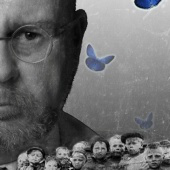
Jonathan Salt as Korczak
Pope John Paul II once described his Jewish countryman, Janusz Korczak, as "a symbol of religion and true morality." Korczak's story is well known in his native Poland where this 70th anniversary year of his death has been designated as The Year of Janusz Korczak. In Britain his story is becoming better known thanks to a remarkable play written and performed by Jonathan Salt, an English Catholic. I recently went to the Kinloss Synagogue in Finchley to see "Confessions of a Butterfly" and was profoundly moved.
Korczak's real name was Henryk Goldszmit. A doctor and paediatrician he was an educator and children's author. He was also director of two children's orphanages - one Jewish and one Catholic.
During the Nazi occupation of Warsaw over 400,000 Jews were confined to an area of 1.3 square miles - the Warsaw Ghetto. During the summer of 1942, at least 254,000 Jewish people from the Ghetto were herded into cattle trucks and removed to the Treblinka extermination camps. Among them were the 192 Jewish orphans at Dom Sierot orphanage. Their director, Dr.Janusz Korczak, was given the opportunity to go into hiding - and was offered a number of chances to escape - but he refused and insisted on accompanying the children in his care to Treblinka.
In August of this year, exactly 70 years after German soldiers sent these children to their deaths, a plaque was placed at the site of the orphanage and wreaths laid at Korczak's statue. A letter was read from Anna Komorowska, Poland's first lady.
If ever we need proof of the rabbi's teaching that "the man who saves a single life saves the world" surely it was the redemptive and sacrificial life of this remarkable pioneer of children's care and education. In a discussion which followed the 90 minute stage production Jonathan Salt explained that it is a life which speaks into our own times.
Salt describes Korczak as "phenomenally brave" and says he "gave children a sense of dignity at a time when the world was stripping it from them" ; that at a moment of crude brutalism this inspirational figure represents bravery and self sacrifice.
During the play many of the children's names are used - along with authentic sayings collected from Korczak's diaries. The children's names reminded me of the Yad Vashem memorial to the Holocaust children in Jerusalem and which underlines the humanity and vulnerability which lies behind harrowing but often incomprehensible statistics.
"Confessions of a Butterfly", for instance, recalls the profoundly moving and poignant story of the boy with the violin - who chooses to become selectively mute after watching the execution of his parents.
Authenticity, vulnerability, fragility and humanity breathes through this one-man play. Salt takes on Korczak's persona as the play recounts these extraordinary stories.
The drama is set in the hours before Korczak left the orphanage, in August 1942, walking ahead of the children to board the cattle trucks. The children were dressed in their best clothes, each carrying a blue knapsack and a favorite book or toy. One eyewitness said:
"Janusz Korczak was marching, his head bent forward, holding the hand of a child, without a hat, a leather belt around his waist, and wearing high boots. A few nurses were followed by two hundred children, dressed in clean and meticulously cared for clothes, as they were being carried to the altar."
Korczak tells the children that, whatever happens to them on their journey, their destination will be a freedom which no adult will then be able to take from them. Salt's play has moments of pathos, humour, self deprecation, and discovery.
Jonathan Salt first became interested in the Jewish educator's story when he heard about it at the Edinburgh Fringe. This led to him playing the part of Korczak in a musical production and then, in 2004, he decided to visit Poland. For him it was a seminal moment as he held Korczak's original diaries in his hands. A visit to Auschwitz was equally "life changing" and led him to create a small company which gives young people the chance to visit the camps and to learn in great detail the
story of the Holocaust.
Salt comes from Cambridgeshire, where he was born in 1964. He studied for seven years at the Canisianum Jesuit seminary in Innsbruck (which was closed by the Nazis during World War Two) and was ordained in the UK in 1990, but left priestly ministry in 1995 - finding a different form of ministry which enables him to use his deep understanding of theology and philosophy to promote a message which the world badly needs to hear.
The contemporary relevance of the life of Janusz Korczak bore down on Salt during a visit to Rwanda where a he met a nine year old boy whose family had been slaughtered by his neighbours during the Rwandan Genocide of 1994 when at least 800,000 people were murdered. Crimes against humanity continue in our own times - from the gulags of North Korea to the slaughter in Darfur and South Kordofan.
Despite the horrors with which it deals "Confessions of a Butterfly" has moments of humour, and there are some lovely scenes where he talks to the imaginary children around him, and even becomes a child himself. Using props like cups or apples thrown onto the stage we can imagine the presence of the children who animated Korczak's life - whom he lived for and gave his life for. Clothes, blankets, and toys are all used to create imaginary conversations with children now long dead but whose spirits are given new life in this sensitive and intimate drama.
At a time when Holocaust deniers try to dispute the veracity or scale of the Shoah - which claimed the lives of six million people - and as we see crimes against humanity visited again on people the world over - from Sudan to north Korea - Salt believes that Korczak's story is like a wakeup call. When we become indifferent to the Holocaust and the savagery of those times it surely paves the way for those terrible events to occur all over again.
To warn us against this, Jonathan Salt's play ought to be staged in colleges and communities up and down this country. Korczak's story is a warning to always guard against racism, xenophobia, anti-Semitism and the scapegoating of minorities but it is also a rebuke to nations who leave their children to suffer as victims of war, trafficking, exploitation, abuse, malnutrition, curable diseases and from the deprivation of education. Korczak's story is a story for our times.
Contact Jonathan Salt at: jonathan@ojemba.com
 Facebook
 Twitter
 LinkedIn
 Print
Print Email
Email













 Facebook
 Twitter
 YouTube
 LinkedIn
 Pinterest