

Pope Benedict: 'liturgy unites the Church universal in every place and age as the Body of Christ.
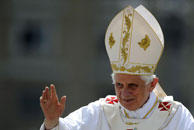
Pope Benedict
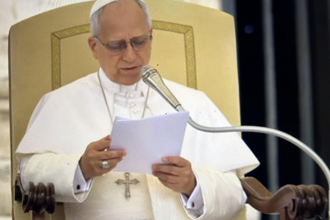
More than 20 thousand pilgrims and visitors gathered in St Peter’s Square on Wednesday for Pope Benedict's general audience. The opening of the XIII Ordinary General Assembly of the Synod of Bishops on the New Evangelisation, is now only days away, while celebrations and events to mark the 50th anniversary of the opening of the Second Vatican Council are already underway- all leading towards the launching of the Year of Faith at the end of the month.
Pope Benedict recalled these three events in his greeting, asking pilgrims to remember them in their prayers. He also asked for prayers for his visit on Thursday to the Marian Shrine of Loreto. There, in the footsteps of his predecessor, Blessed Pope John XXIII, he will entrust these ecclesial efforts to the Blessed Virgin, just as the ‘Good Pope John’ had done 50 years ago on the eve of the great 'Ecumenical Council’.
Earlier, during his catechesis on prayer, Pope Benedict XVI reflected a subject that was at the very heart of Vatican II: How we pray in the Sacred Liturgy and how the liturgy unites the Church universal in every place and age, as the Body of Christ.
Prayer, the Pope explained, "is the living relationship of the children of God with their immeasurably good Father, with His Son Jesus Christ and with the Holy Spirit. Therefore the life of prayer consists in dwelling habitually in the presence of God and knowing Him. ... Such communion of life with the One Triune God is possible through Baptism, by which we are united to Christ, ... because only in Christ can we dialogue with God the Father as children".
For Christians, prayer means "constantly gazing at Christ in ways that are ever new", said the Holy Father. "Yet we must not forget that we discover Christ and know Him as a living Person in the Church. She is 'His Body'. ... The unbreakable bond between Christ and the Church, through the unifying power of love, does not annul 'you' and 'me' but exalts them to their most intense unity. ... Praying means raising oneself to the heights of God, by means of a necessary and gradual transformation of our being".
By participating in the liturgy "we make the language of Mother Church our own, we learn to speak in her and for her. Of course this comes about gradually, little by little. I must progressively immerse myself into the words of the Church with my prayers, life and suffering, with my joy and my thoughts. This is a journey which transforms us", the Pope said.
The question of "how to pray" is answered by following the Our Father, the prayer which Jesus taught us. "We see that its first two words are 'Father' and 'our', and the response then becomes clear: I learn to pray and I nourish my prayer by addressing myself to God as Father, and by praying with others, with the Church, accepting the gift of her words, which little by little become familiar and rich in meaning. The dialogue God establishes with each one of us in prayer, and we with Him, always includes a 'with'. We cannot pray to God individualistically. In liturgical prayer, especially the Eucharist, ... in all prayer, we speak not only as single individuals, but enter into that 'us' which is the prayerful Church".
The liturgy, then, "is not some form of 'self-expression' of a community. ... It means entering into that great living community in which God Himself nourishes us. The liturgy implies universality", and it "is important for all Christians to feel that they are truly part of this universal 'us', which is the foundation and refuge for the 'me', in the Body of Christ which is the Church".
To do this we must accept the logic of the incarnation of God, who "came close to us, making Himself present in history and in human nature. ... This presence continues in the Church, His Body. The liturgy, then, is not the recollection of past events but the living presence of Christ's Paschal Mystery which transcends and unites time and space".
"It is not the individual priest or member of the faithful, or the group, which celebrates the liturgy. Rather, the liturgy is primarily the action of God through the Church with all her history, her rich tradition and her creativity. This universality and fundamental openness, which is specific to all the liturgy, is one of the reasons for which it cannot be invented or modified by a single community or by experts, but must remain faithful to the forms of the universal Church".
The Church becomes fully visible in the liturgy, the Holy Father concluded, "the act by which we believe that God enters our lives and we can encounter Him. The act in which ... He comes to us and we are illuminated by Him".
Source: VIS
 Facebook
 Twitter
 LinkedIn
 Print
Print Email
Email





 Facebook
 Twitter
 YouTube
 LinkedIn
 Pinterest